
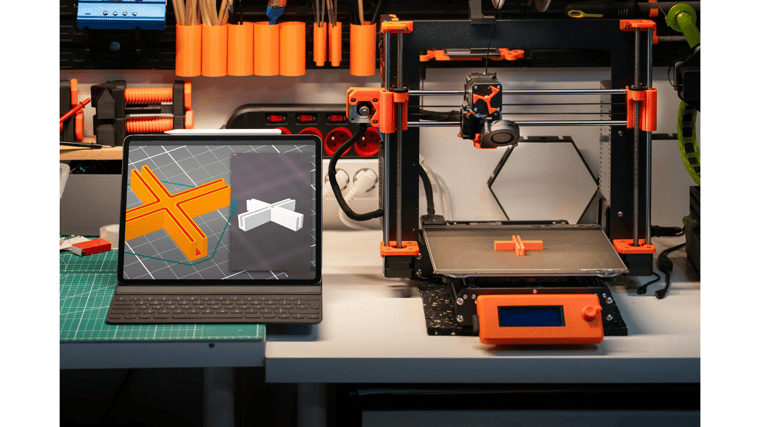
Additive manufacturing (AM)—commonly known as industrial 3D printing—represents a fundamental shift in production philosophy. While subtractive processes like CNC machining cut material away from a solid block, and formative processes like stamping or injection molding rely on high-pressure tooling, additive manufacturing builds complex three-dimensional components layer by layer directly from digital CAD data. Once restricted to rapid prototyping and aesthetic conceptual models, advanced additive technologies now manufacture end-use structural components across aerospace, medical, automotive, energy, and defense sectors.
The primary advantage of additive manufacturing lies in its geometric flexibility. It enables the creation of internal voids, organic lattice structures, integrated cooling passages, and topology-optimized assemblies that are impossible or cost-prohibitive to produce using conventional subtractive machining. Understanding industrial 3D printing requires analyzing its foundational technology families: powder bed fusion, directed energy deposition, stereolithography, material extrusion, binder jetting, and their associated metallurgical and post-processing protocols.
1. Polymer and Resin Additive Manufacturing Technologies
Polymer-based additive systems were the earliest commercial 3D printing applications and remain vital for lightweight functional components, enclosures, jigs, fixtures, and custom medical models.
Fused Filament Fabrication (FFF) / Fused Deposition Modeling (FDM)
FFF operates by driving a continuous strand of thermoplastic filament through a heated extrusion nozzle mounted on a motion control gantry. The nozzle heats the polymer past its glass transition or melting temperature, extruding a fine bead of molten material onto a build platform. The nozzle traces the two-dimensional cross-section of the layer before the build plate drops (or nozzle rises) along the Z-axis to deposit the subsequent layer.
● Materials: Standard engineering thermoplastics including ABS, Polycarbonate (PC), Polyamide (Nylon), and high-performance polyaryletherketones such as PEEK and PEKK, often reinforced with chopped carbon fiber or glass fibers to boost tensile strength and thermal stability.
● Characteristics: FFF is cost-effective and versatile, but introduces structural anisotropy—the mechanical strength along the vertical Z-axis (inter-layer bond strength) is notably lower than along the horizontal X-Y printing plane.
Stereolithography (SLA) and Digital Light Processing (DLP)
SLA and DLP utilize liquid thermosetting photopolymer resins cured selectively by a ultraviolet (UV) light source:
● SLA: A high-precision UV laser traces two-dimensional cross-sections across the surface of a vat filled with liquid resin, photopolymerizing the liquid into a solid layer via cross-linking chemical reactions.
● DLP / Continuous Liquid Interface Production (CLIP): Utilizes a digital projector array to flash an entire two-dimensional image layer simultaneously across the bottom of a transparent resin reservoir. CLIP technology projects a continuous
sequence of UV images through an oxygen-permeable window, creating a continuous “dead zone” that enables rapid, uninterrupted Z-axis motion.
Vat photopolymerization delivers smooth surface finishes, high feature resolution, and tight dimensional tolerances. However, raw photopolymer resins degrade under long-term UV exposure, restricting these technologies primarily to dental models, investment casting patterns, microfluidic devices, and short-term functional prototypes.
Selective Laser Sintering (SLS)
SLS is a powder bed fusion process for polymers. A thin layer of fine polymer powder (typically Nylon 11 or Nylon 12) is spread evenly across a preheated build chamber by a counter-rotating roller or recoater blade. A high-power carbon dioxide ($CO_2$) or fiber laser selectively scans the powder bed, sintering (fusing) the powder particles together at temperatures just below their melting point.
Because the unsintered powder densely surrounding the part acts as a natural support structure, SLS eliminates the need for temporary support structures. This allows engineers to nest hundreds of complex, interlocking geometries inside a single build volume, making SLS a scalable option for low-to-medium batch manufacturing.
2. Metal Powder Bed Fusion (PBF): DMLS and EBM
Metal powder bed fusion is the dominant additive manufacturing class for producing critical, high-load structural metallic components. PBF systems process high-performance engineering alloys, including Ti-6Al-4V titanium, Inconel 718/625 nickel superalloys, CoCr cobalt-chrome, 316L stainless steel, and AlSi10Mg aluminum.
Direct Metal Laser Sintering (DMLS) / Selective Laser Melting (SLM)
DMLS and SLM systems use one or more high-power fiber lasers (ranging from 200W to over 1000W) operating inside a sealed build chamber purged with inert gas (argon or nitrogen) to prevent metal oxidation.
1. A precision recoater blade sweeps a uniform layer of fine spherical metal powder—typically 15 to 45 micrometers in diameter—across a heavy build platform. 2. Galvanometer mirrors direct the laser beam to trace the part cross-section, fully melting the metal powder particles into a dense liquid pool that solidifies rapidly. 3. The build platform lowers by a precise increment (commonly 30 to 60 micrometers), and the process repeats until the part is complete.
Because localized laser heating creates steep thermal gradients, DMLS parts experience severe internal thermal stresses during cooling. Solid support anchors welded to the base
plate are required to tie the part down, prevent thermal curling, support overhangs, and conduct heat away into the build plate.
Electron Beam Melting (EBM)
EBM utilizes a high-energy electron beam inside a high-vacuum chamber instead of a laser in an inert atmosphere. The electron beam is steered electromagnetically at near-light speeds, preheating the entire powder bed to elevated temperatures (often 600°C to 1000°C) before melting each layer.
● Advantages: High bed preheating minimizes thermal gradients, producing virtually stress-free parts that require fewer support structures and no post-build stress-relief heat treatments. EBM is well-suited for crack-sensitive alloys such as Titanium Aluminide (TiAl) and medical-grade titanium implants.
● Limitations: Vacuum requirements, rougher surface finishes, and larger powder particle size distribution (45 to 106 micrometers) compared to laser-based systems.
3. Directed Energy Deposition (DED) and Large-Scale Additive
Directed Energy Deposition (DED) does not use a pre-spread powder bed. Instead, DED systems focus a thermal energy source—such as a laser, electron beam, or electric plasma arc—directly onto a localized region of a substrate while simultaneously feeding raw metal material into the melt pool.
● Powder-Fed DED: High-pressure inert gas streams propel fine metal powder through multi-nozzle deposition heads into the path of a focused laser beam. ● Wire-Fed DED / Wire Arc Additive Manufacturing (WAAM): Uses standard welding wire fed continuously into a multi-axis arc welder or laser deposition head. WAAM achieves high metal deposition rates (often exceeding 5 to 10 kg of metal per hour), making it suitable for manufacturing massive aerospace structural spars, pressure vessels, and maritime components meters in size.
DED is uniquely capable of building features directly onto existing complex parts. This makes it an ideal process for repairing damaged high-value components—such as worn turbine blade tips or damaged heavy industrial shaft journals—without discarding the original parent structure.
4. Binder Jetting and Metal Injection Molding Hybridization
Metal Binder Jetting (MBJ) is a high-speed, high-volume additive technology that decouples the printing phase from the thermal consolidation phase.
1. Printing Phase: A recoater deposits a layer of metal powder across the build bed. An industrial inkjet printhead traverses the bed, selectively depositing a liquid polymeric binding agent into the powder to glue the metal particles together. The process occurs at room temperature without melting, eliminating thermal stresses, warp, and support structure requirements.
2. Curing: The resulting “green” parts are fragile and bound by polymer. They undergo low-temperature thermal curing to harden the binder for safe handling. 3. Debinding and Sintering: The green parts are placed inside a high-temperature vacuum or controlled-atmosphere furnace. The furnace burns off the organic binder (debinding) and elevates the temperature to near the metal’s melting point (sintering). During sintering, atomic diffusion drives the loose metal particles to fuse into a solid metallic structure.
While sintering causes significant isotropic volumetric shrinkage (typically 15% to 20%), software tools compensate for this by scaling the initial CAD geometry up. Binder Jetting offers high throughput and lower equipment costs compared to laser powder bed systems, making it a viable alternative for automotive and industrial component mass production.
5. Design for Additive Manufacturing (DfAM)
To unlock the full value of 3D printing, components must be designed specifically for additive processes rather than simply reproducing subtractive geometries. Key DfAM strategies include:
● Topology Optimization: Mathematical algorithms analyze real-world load paths, stress fields, and boundary constraints to strip away non-critical material, generating organic, skeletal geometries that minimize weight while maintaining structural stiffness.
● Consolidation of Assemblies: Complex mechanical systems featuring dozens of individual machined, fastened, and gasketed parts can be redesigned into a single, unified 3D-printed component. This eliminates assembly labor, reduces seal failure points, and streamlines supply chains.
● Internal Lattice Structures: Solid thick sections can be replaced with internal, repeating triply periodic minimal surface (TPMS) or gyroid lattice structures. Lattices reduce overall mass, lower material costs, enhance thermal dissipation, and match human bone stiffness profiles for orthopedic implants.
6. Post-Processing and Quality Control in Metal Additive
A metal additive part directly out of the build chamber is rarely ready for end-use. Post-processing often accounts for 30% to 50% of the total manufacturing cost of a 3D-printed metal component.
● Stress Relief Heat Treatment: DMLS parts undergo furnace heat treatment while still attached to the build plate to relieve internal residual thermal stresses before removal, preventing part distortion.
● Support Removal and Machining: Mechanical saws or wire-EDM (Electrical Discharge Machining) cut parts off the build plate. Functional interface surfaces, precise bearing seats, and threaded holes are then finish-machined using standard CNC milling centers.
● Hot Isostatic Pressing (HIP): Critical aerospace and medical components are subjected to Hot Isostatic Pressing inside a specialized pressure vessel. The parts
are heated to elevated temperatures under high-pressure inert gas (typically 100+ MPa). This pressure collapses internal micro-voids, keyhole pores, and un-fused powder pockets, bringing the component to near 100% theoretical density and improving its fatigue strength.
● Surface Finishing: As-printed metal surfaces feature a rough texture (Ra values between 5 and 15 micrometers) due to partially fused powder particles. Abrasive flow machining, drag finishing, electropolishing, and chemical chemical etching are applied to smooth internal channels and exterior surfaces.
1.
●
Stainless steel pipes kampala uganda
Stainless steel fabricators Kampala Uganda
Car Parking Shade Kenya
Anti Climb Fence Nairobi Kenya